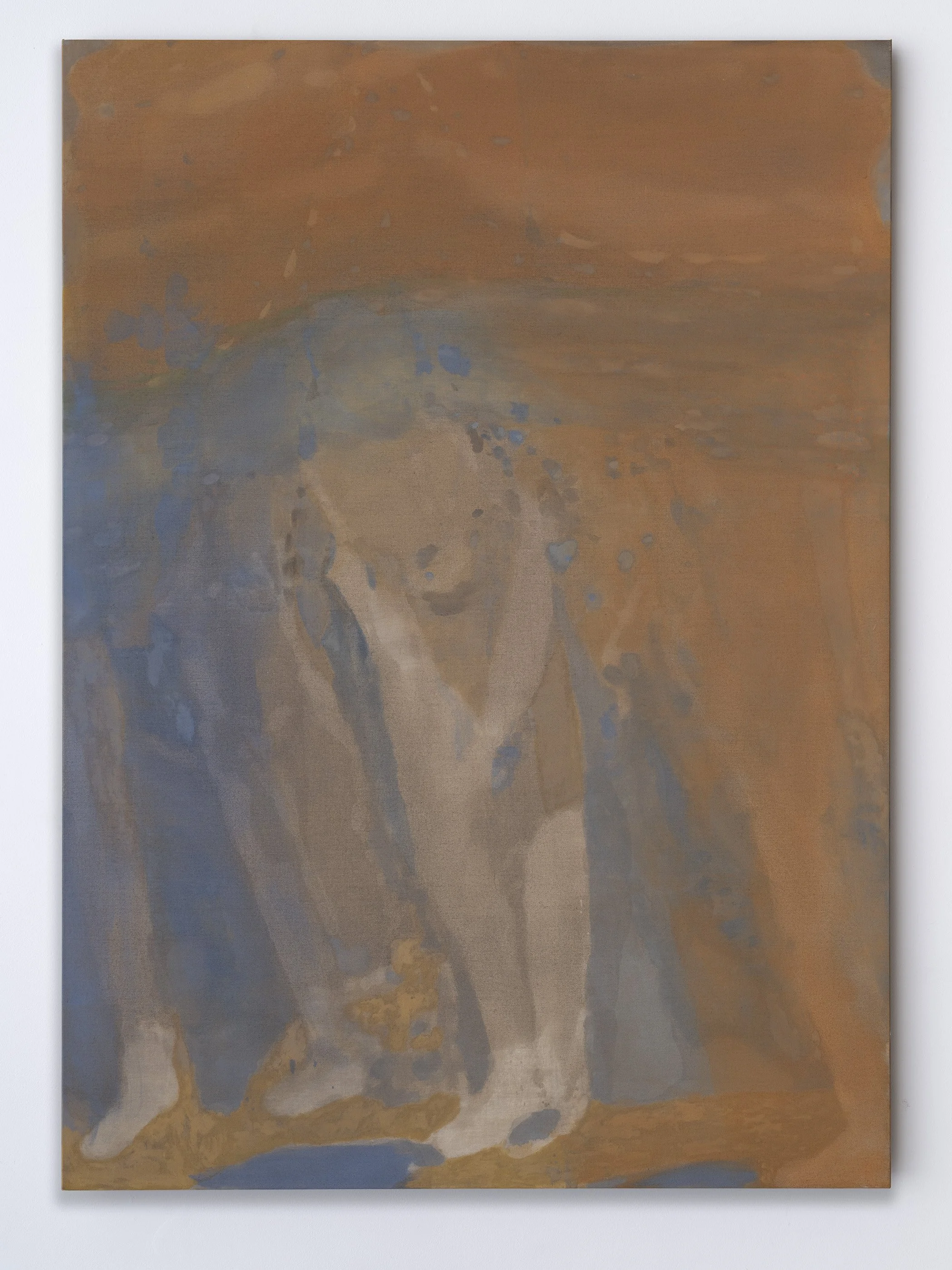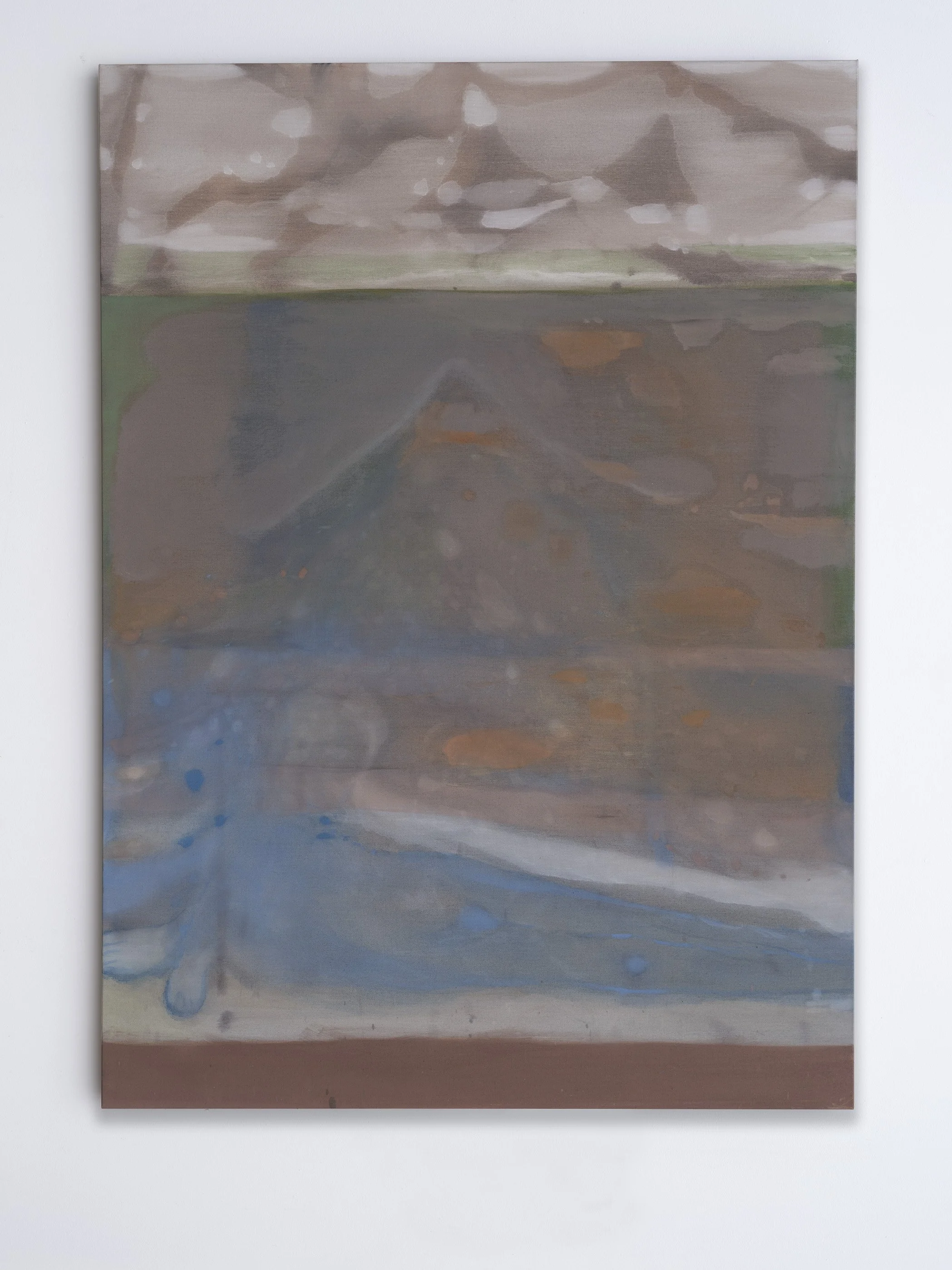
Blue sphinx animal mother/Volcano lover/Rangitoto
Oil on linen
130x160cm
Volcano - Text by Jan Bryant
It feels like being flipped from distant onlooker into possible caresser in Amber Wallis’ new series of paintings titled Volcano (Nasha Gallery 17 September- 17 October 2026). Perhaps the temptation to get close enough to stroke the paintings, a heightened sense of intimacy, comes from Amber’s material choices, her oil paint on raw linen that renders the imagery creamy, washy, even diaphanous. Blue animal sphinx mother/volcano lover/Rangitoto (2026) takes a vertical slice through earth, sea, volcano and grey sky, defying the propensity for arcadian pictorialism found in (European) landscape painting. One section of the image appears to float atop another or even leach into the next, and the earthy, red-brown umber disturbs the calmer blue fields in the image.
The umber colour is named ‘caput mortuum’ (dead head), which is also known as ‘mummy brown’. The name derives from the pigment’s original harvest of mummy flesh, mixed with pitch and myrrh. The colour’s bodily resonance and deathly symbolism has been used generously across the series, but each painting is also abundant with other conceptual connotations. Therefore, I would like to spend a little time with Caput mortuum colour field and figurative puddle (2026) to bring out some of Amber’s thinking.
Unambiguously, the title points to the significance of the burnt umber pigment and to the history of painting itself, referencing the abstract colourfield movement of the mid-20th century—its use of single tints to foreground flatness and surface. European art history seems to pit figuration against abstraction (the mimetic against the non-objective) but despite the homage to abstract art in the title, there are other references in the work itself that make this a false dualism.
Before the supply of mummies waned in the 19th century, caput mortuum was popular with the pre-Raphaelites and their nostalgia for a non-industrial past, and for storytelling in film-stillish images. Today the colour comes from a range of minerals and iron oxides. But its history is secured in the name. Another painting reference is found in the golden core of bright amber that rises out of a darker ground, an effect that reaches back to the love of chiaroscuro in the Renaissance, when pools of light pulled focus from dark surrounding spaces, adding perspective and spectacle.
The figure/object distinction disappears when distance is replaced by closer scrutiny. Sitting underneath the bright, painterly umber is the ghostly shadow of a photograph of intertwining figures. Once a sexual encounter, a ‘puddle’ of linked bodies found in a porn-mag, the bodily form is now dissolved into a single textured painterly field.
Light, painterliness, space, surface, depth, brush strokes… the work feels like a votive offering to the art of painting.
'…It’s the mouth of a volcano. Yes, mouth; and lava tongue. A body, a monstrous living body, both male and female. It emits, ejects. It is also an interior, an abyss. Something alive, that can die. Something inert that becomes agitated, now and then…’ (Susan Sontag, The Volcano Lover (UK: Penguin, 1992) 8–9)
In Māori, the word for “volcano” is “te puia” (eruption, geyser) ruled by the god Rūaumoko who lives under the surface of Aotearoa causing tremors and eruptions. Blue animal sphinx mother/volcano lover/Rangitoto is a rendering of a prominent cone-shaped volcano that forms part of a field of volcanoes that encircle the Isthmus of Tāmaki Makaurau (Auckland). There are fifty-three in total. This is Amber’s birthplace.
Since the Volcano series draws on Amber’s childhood memories, paintings are like channels for communicating something beyond the here and now. Flashes coming from the past, dreamlike and untethered, the leaching of some sections into others, the blurry parts, the layering of form, all contribute to a sense that time has been ‘dislodged’. It turns the urge to create closure into indeterminable, a-temporal surfaces. The Ancient Greek concept of time is helpful here. Moving in parallel, Chronos is singular time, measured and experienced in and through the consciousness of time’s passing, where Aion, or cosmic time is more like memory, in the sense that it is unmeasurable and eternal.
Rangitoto means bloody sky in Māori: a burning red sky, the blackest of abysses ejecting rivers of lava and clouds of ash, sulphuric and desolate, a spectral threat. It is a spectacle, a sexual metaphor, a death drive, a sublimation and purification. This force that menaces life/home while producing verdant harvests, also holds onto the boundless tension between life as an irrepressible force, and the pull of the death drive. The Zen Buddhist concept, Koan a paradoxical anecdote that cannot be resolved by reason, seems an apt description of a volcano. Unlike western philosophy, the aporetic beginnings of a koan are the starting point that facilitates new intuitions and knowledges.
Amber says her paintings are a form of self-healing, but they are also a generous offering to others: they share a haptic, intimate sensibility, and a refusal to be didactic. Those who encounter them will use their own experiences to discover the range of possible meanings.
Jan Bryant
Director, Art Programme
Oil on linen
130x160cm
Oil on linen
97x115cm
Oil on linen
97x115cm
Oil on linen
97x115cm
Oil on linen
150×130cm
Oil on linen
150x190cm
Oil on linen
97x115cm
Oil on lInen
97x115cm
Oil on linen
130x150cm
Oil on linen
130x160cm